Will Iridium Stock Be Delisted After the Acquisition by Rocket Lab?

Yes, assuming the merger closes as announced, Iridium (NASDAQ: IRDM) would no longer trade as a standalone public company. It would effectively be delisted because it will become a wholly owned subsidiary of Rocket Lab.

Here’s what happens:

  • Rocket Lab will acquire 100% of the outstanding Iridium shares in a transaction valued at $54 per IRDM share.
  • Each Iridium shareholder will receive:
    • $27 in cash, plus
    • Rocket Lab (RKLB) shares, with the number of shares determined by an exchange ratio tied to Rocket Lab’s stock price (subject to a collar).

Once the acquisition closes:

  • ✅ IRDM shares will stop trading on Nasdaq.
  • ✅ Your brokerage account will automatically replace your IRDM shares with the cash and RKLB shares you’re entitled to.
  • ✅ The ticker IRDM will be retired unless Rocket Lab chooses some unusual structure (which has not been announced).

Timeline

The companies expect the transaction to close in mid-2027, subject to:

  • Iridium shareholder approval
  • Regulatory approvals
  • Other customary closing conditions.

If you own IRDM today

You have three basic choices:

  1. Sell before closing if you don’t want Rocket Lab shares.
  2. Hold through closing to receive the merger consideration (cash + RKLB stock).
  3. If the deal falls apart, IRDM would continue trading independently, although its stock price could fall back toward its standalone valuation.

One point to watch is the collar on the stock portion. The value is designed to equal $54 per IRDM share, but the number of RKLB shares you receive changes depending on Rocket Lab’s share price at closing.

For more information: https://investors.rocketlabcorp.com/news-releases/news-release-details/rocket-lab-acquire-iridium-historic-deal-creating-fully

** This is not financial advice. Do you own due diligence and/or consult with a licensed financial advisory prior to making financial decisions.
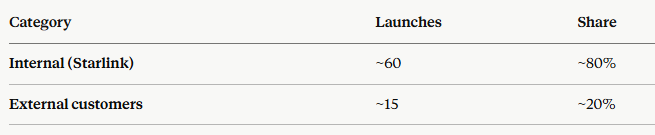
About 80% of SpaceX launches in 2026 thus far has been for SpaceX Starlink

Here’s the breakdown for SpaceX’s Falcon 9 launches in 2026 so far:

Total: ~75 Falcon 9 launches (as of June 28, 2026)

SpaceX has launched 75 Falcon 9 missions so far in 2026, and the vast majority — about 80% — have been dedicated to building out the company’s Starlink constellation. That works out roughly to:

This tracks with the pattern from 2025. In 2025, SpaceX completed 165 Falcon 9 launches, but only 43 were for outside customers — with nearly three-quarters used internally for Starlink. The external customer launches in 2026 have included missions for NASA, the NRO (National Reconnaissance Office), AST SpaceMobile, and commercial satellite operators like SiriusXM.

SpaceX is essentially the world’s largest customer of SpaceX, which lets the company smooth out demand cycles, justify capital investment in reusability, and keep its production lines hot regardless of whether outside customers materialize in any given quarter.

Compared SpaceX to RocketLab customer launches so far in 2026:

Total launches in 2026 so far: 12 (as of June 28)

The most recent launch — “Ten Owl of Ten” on June 26 — was Rocket Lab’s 12th overall launch of 2026, and the 9th for Electron this year. The other 3 flights were performed by HASTE, the suborbital variant of Electron used to test hypersonic technologies.

Since Rocket Lab doesn’t launch satellites for its own constellation the way SpaceX does with Starlink, essentially all of its launches are for customers — it has no internal payload program to speak of. Here’s a snapshot of who those customers have been:

  • Open Cosmos (Jan 22) — 2 Earth observation satellites
  • Confidential commercial customer — undisclosed payload
  • Synspective — multiple Strix SAR satellites (Japanese Earth imaging)
  • JAXA — Japanese research payloads
  • NRO / U.S. government — classified missions
  • iQPS — Japanese SAR satellites
  • HASTE missions (×3) — suborbital hypersonic test flights for U.S. government/defense customers

Rocket Lab set a new company record in 2025 with 21 missions total. At 12 launches through late June, they’re on a similar pace heading into the second half of 2026.

The contrast with SpaceX is stark — where SpaceX uses ~80% of its Falcon 9 flights for its own Starlink network, Rocket Lab’s entire manifest is external customer work.

Firefly Aerospace IPO: Should You Invest in $FLY?

Firefly Aerospace has filed to go public under the ticker $FLY, marking a bold move into the public markets as it aims to compete with private and public players in the space launch industry. While the IPO date hasn’t been announced yet, investors are already taking notice—especially those keeping an eye on emerging space stocks.

Firefly Aerospace vs. Rocket Lab: A Growing Rivalry

Firefly positions itself as a direct competitor to Rocket Lab ($RKLB), targeting the small-to-medium lift launch market with its Alpha rocket. The company is also diversifying into lunar lander technology (via its Blue Ghost program, which is backed by NASA) and broader aerospace and defense contracts. These developments give Firefly a multi-stream approach to revenue, if execution can follow.

🚨 Track Record: 6 Launches, 2 Full Successes

As someone who’s been following Firefly for a few years, I’m cautious. Of their six launches, only two have been fully successful. In the high-stakes world of commercial spaceflight, reliability is non-negotiable. For comparison, Rocket Lab has launched over 40 times and still battles reliability concerns from investors.

📉 Concerns: Cash Burn and Debt

What worries me more than the rockets is the financial structure. Firefly’s cash burn rate and debt levels are aggressive for a company still proving its core services. Unless they tighten up their R&D spending and improve financial transparency, I don’t see a long-term position making sense. (Of course, that’s easier said than done in a capital-intensive industry like this.)

💸 Valuation: Will $FLY Stock Be Overpriced?

Let’s talk numbers. Given the hype around IPOs lately—especially in tech and space—I wouldn’t be surprised to see Firefly’s IPO priced above $20 per share. Personally, I’d need to see it under $10 to even consider investing at this early stage. At that price, the risk-reward balance starts to look more interesting for speculative investors.


🔍 Final Thoughts: Worth Watching, But Not Jumping In (Yet)

Firefly Aerospace is an exciting player in a fast-evolving industry. The commercial space sector is projected to grow massively over the next decade, and companies like Firefly could capture meaningful market share. But with a shaky launch success rate, unclear profit path, and rising competition from SpaceX, Blue Origin, and Rocket Lab, it’s too early for me to go long.

If you’re into speculative investing, $FLY is worth tracking—but only if the IPO price makes sense.